
About
I am a PhD student in Electronic and Electrical Engineering at the University of Southampton. I work on legged locomotion and robot learning, and I built the quadruped that my experiments run on.
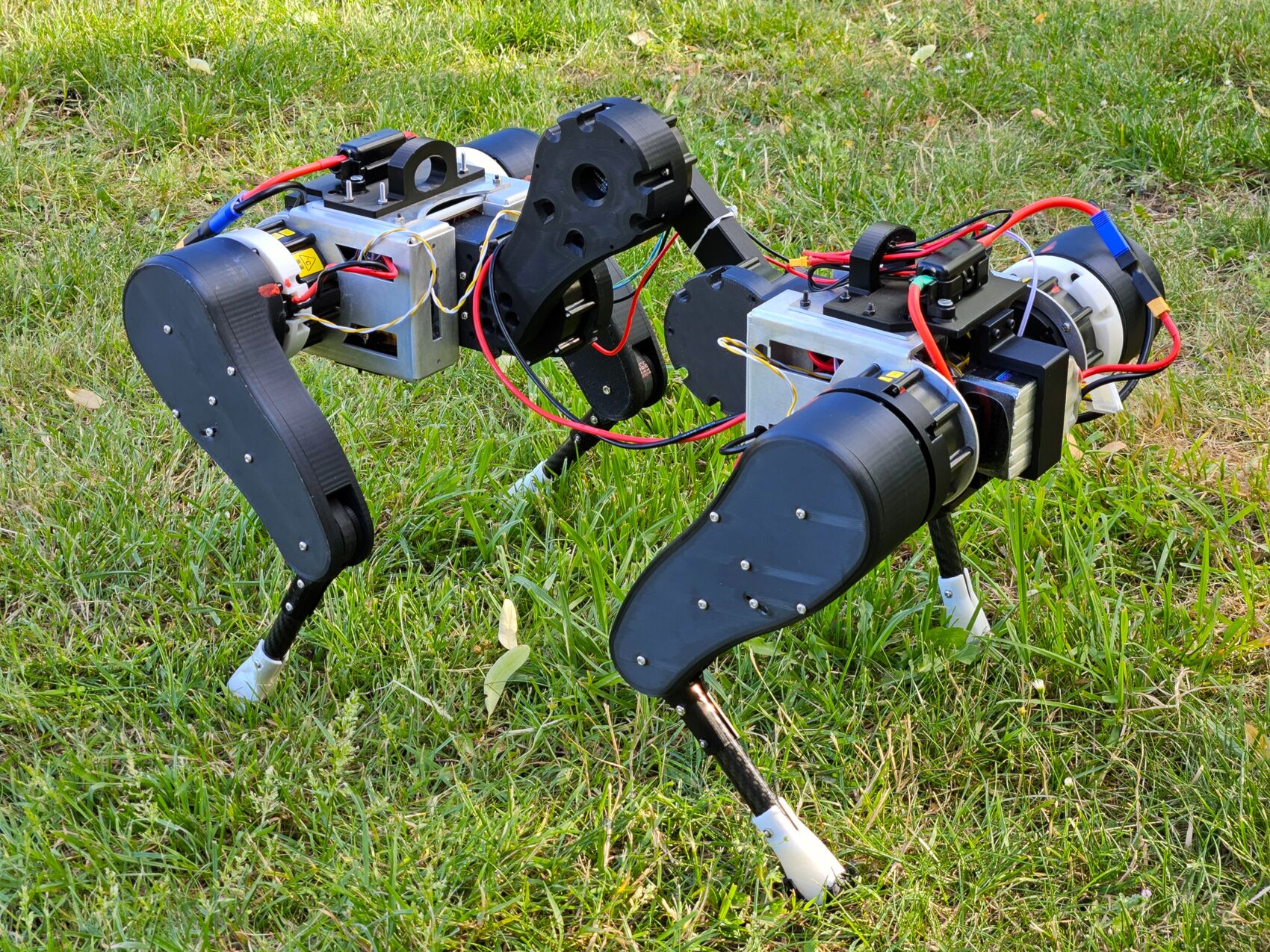
Parts and transmission, circuit boards, firmware, dynamics, controllers, and the learning policies on top: I have been through the whole chain myself. So when I look at a control algorithm I tend to ask first how it lands on hardware. Which board does it run on, how much time margin is left in the loop, and whether backlash in the gearbox will eat the gain I just tuned.
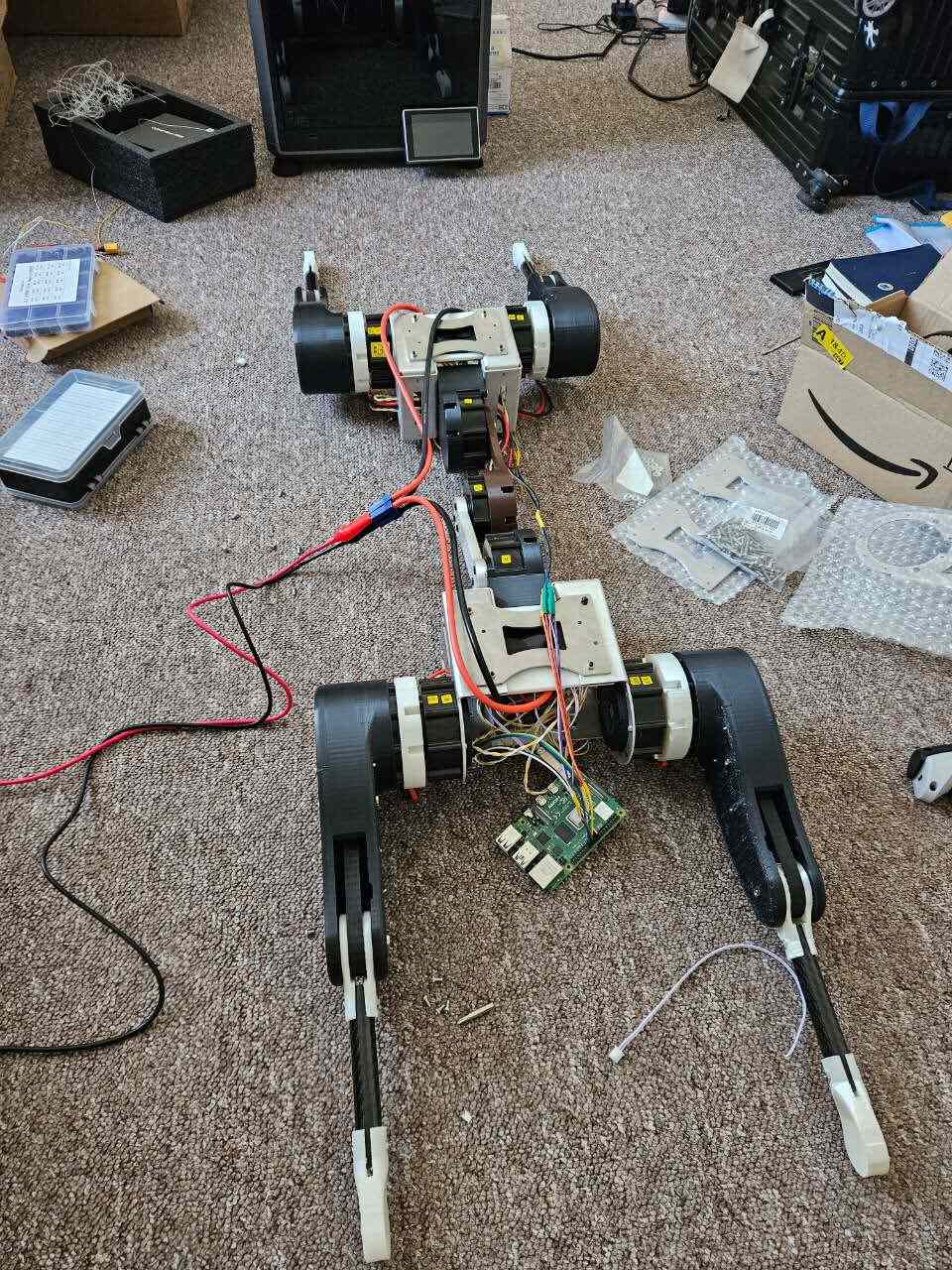
That is where it started, in 2023, on a carpet surrounded by loose parts.
The robot weighs 6.66 kg and has eight degrees of freedom. I started building it alone in 2023. The legs use a parallel joint arrangement with belt-driven knees to keep leg inertia low, and the main controller is an STM32G473 board I laid out myself, closing the loop at 1 kHz under FreeRTOS. Pinocchio and RBDL do not fit on a microcontroller, so I rewrote floating-base rigid body dynamics in C. RNEA and CRBA together take 290 µs per cycle, which leaves about 70% of the 1 ms budget free.
On that robot sits SPARC, a 1.26 kg three-degree-of-freedom active compliant spine that lets the trunk bend and extend along its axis at the same time. Across 97 bounding runs on hardware, the compliant spine under impedance control reached 1.029 m/s, 1.53 times the rigid-spine maximum. I am now putting the same question through Isaac Lab with Adversarial Motion Priors, to find out what an articulated spine actually does for a learned gait.
Selected Publications
View All →Batched Differentiable Rigid Body Dynamics in PyTorch for GPU-Accelerated Robot Learning
Yue Wang, Yanran Xu, Wenbo Wu, Chuanhang Qiu, Zhaoxing Li
International Conference on Artificial Neural Networks (ICANN)
A floating-base robot dynamics library written in plain PyTorch, covering URDF parsing, FK, Jacobians, RNEA, CRBA, ABA and autodiff. On an H200 at batch 4096 it reaches 64x and 63x the throughput of Pinocchio for FK and Jacobians.
SPARC: Spine with Prismatic And Revolute Compliance for Faster Quadrupedal Bounding
Yue Wang, Yanran Xu
arXiv preprint arXiv:2510.01984
A 1.26 kg three-DoF sagittal spine module that combines revolute and prismatic compliance, with a floating-base impedance controller that sets stiffness and damping in task space. Across 97 bounding runs on an 8-DoF quadruped it reached 1.029 m/s, 1.53x the rigid-spine maximum. First posted October 2025, latest revision September 2026.
Quattro: Transformer-Accelerated Iterative Linear Quadratic Regulator Framework for Fast Trajectory Optimization
Yue Wang, Haoyu Wang, Zhaoxing Li
IEEE Conference on Decision and Control (CDC)
A Transformer predicts the feedback and feedforward matrices of iLQR in parallel, cutting the sequential bottleneck. Up to 27x faster per optimisation iteration on a quadrotor, 17.8x on the full MPC loop, and 27.3x once deployed on FPGA.